

Schools across India are moving towards smarter and more accountable administration. Attendance is one of the most important daily tasks in any educational institution, yet it is often handled through methods that take time, create confusion, and leave room for mistakes. Manual registers and basic entry methods may still work in small settings, but they often become difficult to manage as the number of students and staff grows.
This is where biometric and RFID attendance systems have become highly valuable. These technologies help schools record attendance quickly, accurately, and securely. They also support better communication with parents, improve monitoring, and reduce the workload of teachers and administrators.
In today’s digital learning environment, schools need systems that do more than just mark presence. They need tools that support safety, transparency, and efficiency. Biometric and RFID attendance solutions are now playing a central role in helping schools build that future.
What Is a Biometric Attendance System for Schools and How Does It Work?

A biometric attendance system records attendance by using a unique physical identity of a person, such as a fingerprint, face, or iris pattern. In schools, this system helps identify students and staff accurately without depending on paper registers or manual verification. Since every person has a unique biometric identity, the chances of attendance errors become much lower.
Why schools prefer biometric attendance?
Biometric systems are useful because they create a direct and reliable record. A student cannot easily mark attendance for another student. This helps schools maintain honesty and discipline in day to day operations. Teachers also spend less classroom time on attendance work and can focus more on teaching.
How the process supports administration?
When a student scans a fingerprint or face at the device, the system records the time instantly and updates the attendance database. This allows school authorities to access daily reports, late entry details, and attendance summaries with less effort. It is especially helpful for institutions that want a more professional and technology driven approach to administration.
How Does an RFID Attendance System Improve Student Tracking in Schools?
RFID stands for Radio Frequency Identification. In schools, students carry an RFID card or ID tag that is read by a scanner when they enter or leave a campus area. This makes attendance recording smooth and contactless. It is especially useful for younger students because it is simple to use and does not require direct physical contact with the device.
Better entry and exit visibility
RFID systems help schools track student movement more effectively. When a student enters the gate, boards a bus, or enters a classroom area where RFID readers are installed, the system can log the activity. This improves visibility and helps schools know whether the student has arrived safely.
Helpful for parents and school safety
RFID attendance also supports parent communication. In many modern school systems, attendance updates can be connected to alerts or app notifications. This gives parents confidence and allows schools to respond quickly if a student is absent or delayed. In a time when student safety is a top priority, RFID offers practical value beyond attendance alone.
Why Biometric & RFID Attendance Is Essential for Schools Today?
Today’s schools are expected to operate with greater transparency, speed, and security. Parents want timely updates, teachers need relief from repetitive tasks, and management teams want accurate reports for better decisions. Biometric and RFID attendance systems meet all these expectations in a practical way.
Why these systems matter now?
Modern schools are handling larger student databases, digital records, and increased expectations around safety. Traditional attendance methods often struggle to match this pace. Biometric and RFID tools reduce confusion and create dependable digital records that can be reviewed anytime.
Essential for trust and accountability
These systems also support trust. When attendance records are accurate and available in real time, schools can answer parent concerns more confidently. They can monitor attendance patterns, identify irregularities, and act faster when issues arise.
In simple terms, biometric and RFID attendance is essential today because it improves both operational control and the educational environment.
How Do Automated Attendance Systems Reduce Manual Errors in School Administration?

Manual attendance often leads to missed entries, unclear handwriting, delayed updates, and accidental mistakes in record keeping. These problems may seem small on a single day, but over weeks and months, they can create confusion in reports, parent communication, and compliance records.
Common problems with manual attendance
- Attendance may be entered late
- Reports may not match daily records
- Proxy marking becomes difficult to detect
- Teachers lose instructional time
Automated attendance systems solve these issues by recording data instantly. Once the attendance is marked through biometric or RFID technology, the information is stored directly in the system. This reduces dependence on manual entry and lowers the chance of human error.
Stronger record management
Automated systems also make data retrieval easier. School leaders can view attendance by class, student, date, or term without going through stacks of registers. This saves time during audits, meetings, and academic reviews. For schools aiming to build a reliable and efficient administration process, automation is no longer just helpful. It is becoming necessary.
How Does a Digital Attendance System Enhance Student Safety and Real Time Monitoring?
A digital attendance system is not limited to marking present or absent. It also plays an important role in student safety. Real time monitoring helps school management understand who is on campus, when they entered, and whether any attendance patterns need immediate attention.
Faster response to absence and delay
If a student does not arrive at school as expected, the system can help identify the issue quickly. Instead of waiting until the end of the day, school staff can take action earlier. This improves response time and supports safer campus management.
These systems create a more connected environment where information is available at the right time. That is one of the biggest reasons schools are adopting digital attendance technology today.
What Are the Benefits of Using Biometric Fingerprint and RFID Card Attendance in Schools?
Biometric fingerprint systems and RFID card systems both offer major benefits, and many schools choose one or combine both depending on their needs. The real advantage is not just in technology itself, but in how it improves the overall school experience.
Key practical benefits
- Faster attendance recording
- Better accuracy in daily records
- Lower chances of proxy attendance
- Improved discipline and punctuality
- Easier reporting for school management
Better use of staff time
When teachers are freed from repetitive attendance work, they can focus more on classroom engagement and student support. Administrative teams also gain more time for planning, communication, and school operations. For Indian schools that are growing and modernising, these benefits can make a visible difference in everyday functioning.
How Can School Management Software with Attendance Improve Overall School Efficiency?
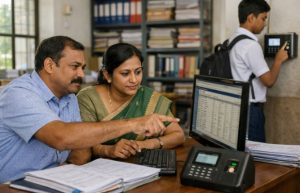
Attendance systems become even more effective when they are linked with school management software. This creates a central platform where attendance data can support academic records, fee management, communication, and reporting. Instead of working with separate tools, schools can manage multiple operations in one integrated system.
Why integration matters?
An integrated system helps management view attendance trends alongside other student information. This gives schools a fuller understanding of student performance and participation. It also supports better planning for meetings, exams, and parent communication.
With the right software, attendance becomes more than a daily routine. It becomes a useful part of a smart school ecosystem that supports quality education and stronger administration.
Conclusion
Biometric and RFID attendance systems are changing the way schools manage one of their most important daily responsibilities. They bring speed, accuracy, transparency, and safety into the attendance process while reducing manual effort for teachers and administrators.
In today’s school environment, where parents expect timely updates and institutions aim for better accountability, these systems provide a practical and future ready solution.
For schools in India, the value is especially clear. As institutions continue to adopt digital tools, biometric and RFID attendance can help create more organised campuses, improve trust with parents, and support better decision making. A smart attendance system is no longer just a convenience. It is becoming an essential part of modern school management.
FAQs
What is the difference between biometric and RFID attendance systems in schools?
A biometric system identifies a student through a unique physical trait such as a fingerprint or face. An RFID system identifies the student through a card or tag that is scanned by a reader. Both help schools record attendance quickly, but the method of identification is different.
Are biometric attendance systems safe for students to use in schools?
Yes, biometric attendance systems are generally designed for secure and controlled use. When implemented properly with responsible data handling and school level privacy practices, they can offer safe and reliable attendance management.
Can RFID attendance systems send real time attendance updates to parents?
Yes, many RFID based systems can be connected with school software or mobile communication tools to send timely attendance alerts to parents when a student enters or leaves the campus.
How does an automated attendance system help teachers save time?
An automated attendance system reduces the need for manual roll calls and register updates. This allows teachers to spend more time on teaching, classroom interaction, and student support.