
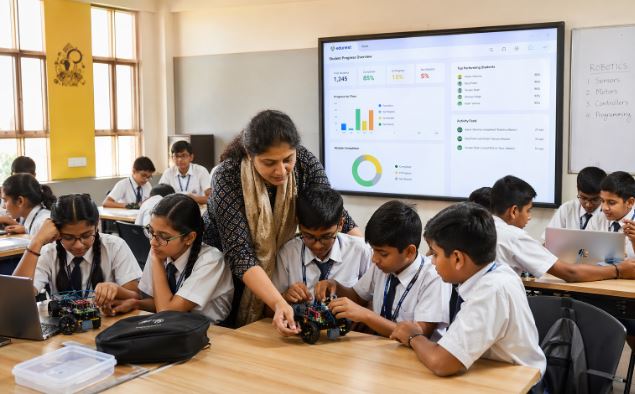
Have you ever wondered how robotics for kids is transforming the way schools manage learning and technology? In today’s rapidly evolving educational landscape, robotics is no longer limited to labs or competitions. It is becoming a core part of modern education systems, especially when integrated with ERP platforms.
This combination helps schools in India create smarter classrooms, improve student engagement, and prepare children for future careers through practical and technology driven learning experiences.
Why Is Robotics for Kids Becoming Crucial in Modern Education?
Robotics for kids has gained significant importance in modern education due to the shift towards digital and skill based learning. Schools are moving beyond traditional teaching methods and adopting interactive approaches that help students understand concepts through real world applications.
In India, education systems are increasingly focusing on STEM learning, where robotics plays a central role. It allows students to engage with science and technology in a practical manner rather than just theoretical study. Robotics also supports experiential learning, which is proven to improve retention and understanding.
Students who learn robotics at an early stage develop a stronger interest in subjects like mathematics and science. It also encourages curiosity and innovation, which are essential qualities in today’s competitive world.
Key Educational Shifts
- Transition from rote learning to practical understanding
- Increased use of digital tools in classrooms
- Focus on skill development alongside academics
These changes highlight why robotics is becoming a necessity rather than an option in modern education.
How Does Robotics for Kids Improve STEM Learning and Practical Skills?
Robotics for kids plays a major role in strengthening STEM education by combining science, technology, engineering, and mathematics into a single learning experience. Instead of studying these subjects separately, students apply them together while building and programming robots.
This hands on approach helps children understand complex concepts more easily. For example, while working on a robotics project, students learn coding, logical thinking, and engineering basics simultaneously. This integrated learning method improves both academic performance and practical skills.
Robotics also enhances problem solving abilities. When a robot does not function as expected, students are encouraged to analyse the issue and find solutions. This process builds critical thinking and resilience.
Some important benefits include:
- Better understanding of coding and automation
- Improved analytical and logical thinking
- Enhanced teamwork through group projects
By integrating robotics into STEM education, schools create a more engaging and effective learning environment.
What Makes Robotics for Kids Essential for ERP Education?
Robotics for kids becomes even more powerful when combined with ERP education systems. ERP platforms help schools manage academic data, track student progress, and streamline administrative tasks. When robotics is integrated into this system, it enhances both teaching and learning processes.
ERP systems can monitor students’ progress in robotics activities, track their skill development, and provide insights to teachers. This allows educators to personalise learning experiences based on individual student needs.
In smart classrooms, robotics tools connected with ERP platforms create a seamless digital learning environment. Teachers can assign robotics projects, evaluate performance, and maintain records efficiently.
This integration also supports better communication between teachers, students, and parents. Parents can track their child’s progress in robotics learning through ERP dashboards.
Overall, combining robotics with ERP education leads to:
- Improved learning management
- Data driven teaching strategies
- Better student performance tracking
This makes robotics an essential component of modern ERP based education systems.
How Can Robotics for Kids Enhance Problem Solving and Creativity?
Robotics for kids is highly effective in developing problem solving skills and creativity. When students work on robotics projects, they are required to think critically and come up with innovative solutions.
Unlike traditional learning methods, robotics encourages experimentation. Students can test different ideas, learn from mistakes, and improve their designs. This process builds confidence and fosters creativity.
Robotics also promotes logical thinking. Children learn to break down complex problems into smaller steps and solve them systematically. This skill is valuable not only in academics but also in real life situations.
Creative Learning Outcomes
- Encourages innovation and imagination
- Develops independent thinking
- Builds confidence through project completion
By engaging in robotics activities, children become more adaptable and capable of handling challenges effectively.
What Role Do Robotics Kits and Programs Play in Child Development?
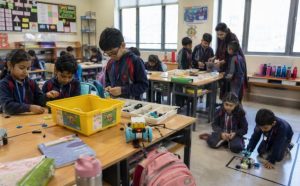
Robotics kits and structured programs are essential tools for introducing robotics to children. These kits are designed to be user friendly and suitable for different age groups, making learning accessible and enjoyable.
Robotics kits allow students to build models, program them, and see immediate results. This interactive learning approach keeps children engaged and motivated. It also helps them understand how technology works in real life.
Structured robotics programs provide a clear learning path. They guide students from basic concepts to advanced applications, ensuring continuous skill development.
Types of Robotics Kits for Children
- Beginner kits for basic understanding
- Intermediate kits for coding and design
- Advanced kits for AI and automation projects
Learning Through Play and Experimentation
Children learn best when they are actively involved. Robotics programs use play based learning methods to make education fun and effective. This approach improves both cognitive and social skills.
Robotics kits and programs play a crucial role in shaping a child’s overall development by combining education with creativity and innovation.
Why Should Schools in India Integrate Robotics with ERP Systems?
Schools in India are increasingly adopting ERP systems to manage their operations efficiently. Integrating robotics with these systems adds significant value to the overall education process.
ERP platforms help schools organise academic activities, manage student data, and improve communication. When robotics is included, it enhances the quality of education by providing practical learning opportunities.
This integration also supports government initiatives promoting digital education and skill development. It prepares students for future careers in technology driven industries.
Benefits for Indian schools include:
- Streamlined academic and administrative processes
- Enhanced student engagement through technology
- Improved tracking of skill based learning
By combining robotics with ERP systems, schools can create a modern and efficient educational environment that meets the needs of today’s learners.
How Does Robotics for Kids Prepare Students for Future Technologies?
Robotics for kids plays a key role in preparing students for future technologies such as artificial intelligence, automation, and machine learning. These technologies are shaping industries across the world, and early exposure gives students a competitive advantage.
Learning robotics helps children understand how machines work and how they can be programmed to perform tasks. This knowledge forms the foundation for advanced technological skills.
Students also develop adaptability, which is essential in a rapidly changing world. They become comfortable working with new technologies and are better prepared for future challenges.
Future Ready Skills Developed
- Coding and programming knowledge
- Understanding of automation systems
- Ability to work with emerging technologies
By learning robotics at an early stage, students are better equipped to succeed in future careers and contribute to technological advancements.
Conclusion
Robotics for kids is no longer just an extracurricular activity. It has become an essential part of modern education, especially when integrated with ERP systems. This combination enhances learning experiences, improves skill development, and prepares students for future technologies.
In India, schools that adopt robotics and ERP integration are better positioned to provide quality education that meets global standards. By focusing on practical learning and digital tools, robotics helps shape a generation of innovative and skilled individuals ready for the future.
FAQs
What age is suitable for children to start learning robotics?
Children can start learning robotics as early as 5 to 7 years old with basic kits and guided programs that focus on simple concepts and play based learning.
Is robotics education expensive for schools and parents in India?
Robotics education can be affordable with scalable kits and institutional programs, and many schools are adopting cost effective solutions to make it accessible.
Do children need coding knowledge before learning robotics?
No, beginners can start robotics without prior coding knowledge as most programs introduce coding gradually through simple and interactive methods.
How do robotics classes support academic performance?
Robotics classes improve understanding of subjects like mathematics and science by providing practical applications, which enhances overall academic performance.
Can robotics be integrated into non technical subjects?
Yes, robotics can be used in subjects like art and design or even storytelling, helping students apply creativity along with technical skills.