
In today’s evolving education system, schools are constantly looking for better ways to make STEM learning more engaging and practical.
How can students truly understand scientific concepts beyond textbooks? Science parks offer an innovative solution by transforming traditional learning into interactive experiences.
These outdoor learning environments combine play with education, helping students explore scientific principles in a natural and enjoyable way. By using real models and experiments, science parks make STEM education more accessible, effective, and memorable for students across different age groups.
Why Are Science Parks Important for STEM Education in Schools?
Science parks play a vital role in modern STEM education by bridging the gap between theory and practice. In many classrooms, students learn concepts through books and lectures, which may limit their understanding. Science parks change this by allowing students to experience science in action.
These parks create an environment where students can explore and question concepts freely. They encourage curiosity and active participation, which are essential for deeper learning. Instead of memorizing formulas, students observe how scientific principles work in real life.
Role in modern education
Science parks support schools by offering practical exposure to subjects like physics, mathematics, and chemistry. They also promote scientific literacy and help students relate concepts to everyday life.
- Encourages active learning
- Improves concept clarity
- Builds curiosity and interest
What Makes Science Parks an Effective Hands On STEM Learning Environment?
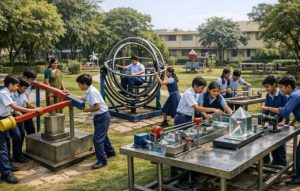
Science parks are designed to provide hands on learning experiences that make STEM subjects more engaging. Students interact directly with equipment and models, which helps them understand complex topics more easily.
According to the VAPS Science Park solution, these parks include interactive open air models that allow students to explore scientific principles through self discovery. This method enhances learning by involving both observation and participation.
Key features of effective learning
Students can touch, experiment, and analyze results on their own. This active involvement improves retention and understanding.
- Learning through interaction
- Real time experimentation
- Visual representation of concepts
Science parks also create a stress free learning environment where students feel motivated to explore without pressure.
How Do Science Parks Help Students Learn STEM?
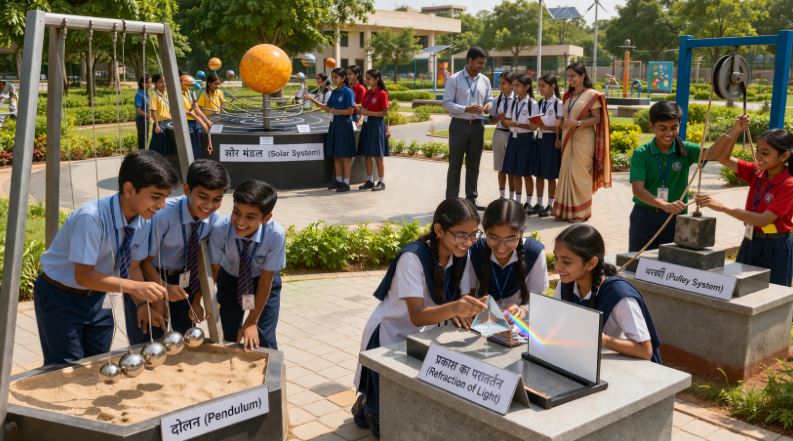
Science parks help students learn STEM by turning abstract concepts into real world experiences. When students interact with models such as pendulums, pulleys, or optical illusions, they gain a practical understanding of how theories work.
These parks provide opportunities to explore subjects like mechanics, optics, and motion in a simple and engaging way. Students can experiment multiple times until they fully understand the concept.
Real world learning approach
By connecting theory with practice, science parks improve problem solving skills and analytical thinking. Students also develop a deeper interest in STEM subjects.
The VAPS science park allows students to explore scientific principles outside the classroom, making learning more dynamic and enjoyable.
How Do Outdoor Science Park Installations Improve Student Engagement?
Outdoor science park installations attract students naturally because they combine play with education. These setups encourage students to spend more time exploring and experimenting, even during their free time.
Unlike traditional classrooms, outdoor environments provide freedom to move, interact, and collaborate with peers. This makes learning more enjoyable and less restrictive.
Engagement through interaction
Students are more likely to remember concepts when they learn through experience. Outdoor science models simplify complex ideas and make them easier to understand.
- Encourages teamwork and collaboration
- Makes learning fun and interactive
- Improves attention and participation
Science parks also help students develop social skills while learning, which adds to their overall growth.
What Types of Educational Models Are Used in Science Parks by VAPS Group?
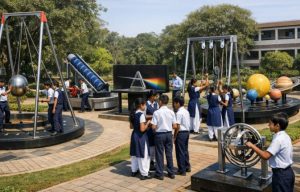
VAPS Group offers a wide range of science park models designed to suit different school needs. These models cover various scientific concepts and provide practical demonstrations of theoretical lessons.
Some popular models include pendulums, prisms, pulleys, gyroscopes, and solar system displays. These tools help students understand topics like motion, light, energy, and force in a simple way.
Features of VAPS science park solutions
VAPS provides over 30 interactive models that can be customized based on school requirements.
| Model Type | Learning Area | Example |
| Motion Models | Physics | Pendulum, Pulley |
| Optical Models | Light | Prism, Optical Illusion |
| Mechanical Models | Force | Lever, Gear |
| Astronomy Models | Space | Solar System |
These models are durable, easy to maintain, and supported with training and study materials for teachers.
How Do Science Parks Support Innovative Teaching Methods in STEM?
Science parks support innovative teaching by offering a practical approach to education. Teachers can use these parks as extended classrooms where lessons are demonstrated rather than explained.
This approach encourages students to ask questions, test ideas, and learn through observation. It also helps teachers explain complex concepts in a simple and effective way.
Integration with curriculum
Science parks can be easily integrated into school curricula. Teachers can plan activities and experiments that align with classroom lessons.
Students benefit from a combination of theoretical and practical learning, which improves their overall academic performance.
What Are the Long Term Benefits of Science Parks for Students and Schools?
Science parks provide long term benefits by building a strong foundation in STEM education. Students who learn through practical experiences are more likely to retain knowledge and apply it in real life.
These parks also inspire students to pursue careers in science and technology by making learning interesting and meaningful.
Key long term advantages
- Enhances critical thinking skills
- Builds confidence in problem solving
- Encourages interest in STEM careers
Schools benefit by offering advanced learning facilities that improve their educational standards and attract more students.
Conclusion
Science parks have transformed the way students learn STEM by making education interactive, practical, and enjoyable. They provide a unique platform where students can explore scientific concepts beyond textbooks and classrooms.
With the help of innovative models and outdoor installations, science parks create a learning environment that encourages curiosity, creativity, and critical thinking.
Solutions like those offered by VAPS Group highlight how schools can effectively implement these parks to enhance student learning. As education continues to evolve, science parks will play an essential role in shaping future ready learners.
FAQs
How do science parks differ from traditional classrooms in STEM education?
Science parks focus on practical learning, while traditional classrooms rely more on theoretical teaching.
Are science parks suitable for all age groups in schools?
Yes, science parks are designed to cater to students of different age groups. The models can be customized based on learning levels, making them suitable for primary, secondary, and higher education students.
What subjects can students learn in a science park?
Students can learn various STEM subjects such as physics, chemistry, mathematics, and basic engineering concepts. These parks cover topics like motion, light, energy, and forces through practical models.
How do science park models help in understanding complex scientific concepts?
Science park models simplify complex theories by presenting them in a visual and interactive format. Students can observe and experiment with these models, which makes it easier to understand difficult concepts.
Can science parks improve students interest in STEM careers?
Yes, science parks make learning enjoyable and engaging, which increases students interest in STEM fields.