
In 2026, schools across India are rapidly adopting digital solutions to simplify administration, improve academic management, and enhance communication with parents.
VAPS School ERP has emerged as a comprehensive school management software that supports admissions, attendance, examinations, fee management, communication, and academic tracking in one unified platform. However, the success of any ERP implementation depends largely on how well the staff is trained to use it.
Training staff to use VAPS School ERP efficiently is not just about teaching them how to click buttons. It involves building confidence, ensuring accurate data entry, encouraging digital adoption, and aligning school processes with the software modules.
When teachers and administrative staff understand the system properly, the institution benefits from smoother operations, better reporting, and improved transparency.
This guide explains how schools can effectively train their staff to use VAPS School ERP with clarity, structure, and long-term efficiency.
Why Is VAPS School ERP Training Important for Schools in India?

Proper VAPS School ERP training ensures that schools fully utilise the features designed to simplify academic and administrative tasks. Without structured training, staff may only use limited modules, which reduces the overall effectiveness of the system.
In Indian schools, the administrative workload is often high. Manual processes can lead to delays, errors, and communication gaps.
VAPS ERP addresses these challenges by offering integrated modules such as student information management, fee tracking, timetable scheduling, and parent communication. However, if staff members are not confident in using these modules, the school may struggle with adoption.
Key benefits of structured training
- Improved data accuracy and reduced manual errors
- Faster completion of administrative tasks
- Better coordination between departments
- Increased teacher productivity
- Enhanced parent engagement through timely updates
Training also supports digital transformation initiatives promoted across the Indian education sector. When staff members are comfortable with ERP systems, schools become more organised, transparent, and efficient.
How to Assess Staff Readiness Before Implementing VAPS ERP?
Before starting formal training, schools must evaluate staff readiness. This step ensures that the training programme is tailored to the needs of teachers, administrators, and support staff.
Conducting a basic skill assessment
School management can assess digital literacy levels by understanding:
- Familiarity with computers and basic software
- Experience with previous school management systems
- Comfort level with online data entry and reporting
Some staff members may require basic computer orientation before ERP training begins. Identifying these gaps early helps avoid frustration during implementation.
Understanding department-specific requirements
Administrative staff may need deeper training in fee management, admissions, and reporting modules. Teachers may require focused sessions on attendance, grade entry, and academic performance tracking. By mapping roles to ERP modules, schools can design a more structured and effective VAPS ERP onboarding process.
Assessing readiness also builds confidence among staff. When they feel supported rather than forced into change, ERP adoption becomes smoother and more successful.
How to Train Staff to Use VAPS School ERP Efficiently?
Training staff efficiently requires a systematic and practical approach. Instead of overwhelming them with all features at once, schools should introduce modules gradually.
Step-by-step training plan
- First, organise orientation sessions explaining the purpose and benefits of VAPS School ERP. This helps staff understand why the change is necessary.
- Second, provide module wise training. Focus on one area at a time, such as attendance management or student records. Demonstrate real scenarios relevant to daily school operations.
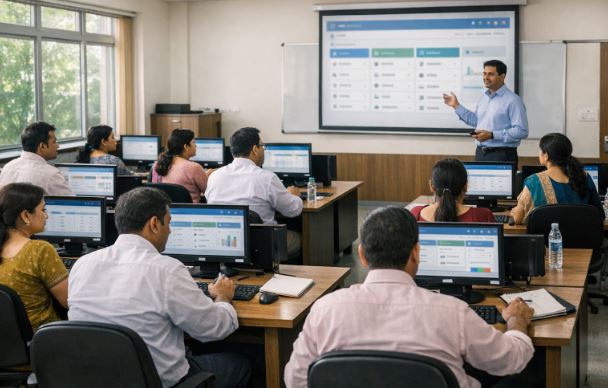
- Third, conduct hands-on practice sessions. Practical exposure allows staff to explore dashboards, enter data, and generate reports confidently.
- Fourth, provide user manuals and short video guides for revision. These resources act as references whenever doubts arise.
- Fifth, assign ERP coordinators within the school. These trained individuals can assist colleagues and ensure proper usage.
Regular follow-up sessions are equally important. Training should not be a one-time event but an ongoing process that strengthens skills over time.
What Modules of VAPS ERP Should Teachers and Administrators Learn First?

To avoid confusion, schools must prioritise essential modules during initial training. The most frequently used modules should be introduced first.
For teachers
Teachers should focus on:
- Attendance management
- Examination and grade entry
- Homework and assignment updates
- Student performance tracking
- Parent communication tools
These modules directly impact classroom management and academic reporting.
For administrative staff
Administrative teams should begin with:
- Admission management
- Fee collection and accounting
- Student information system
- Timetable scheduling
- Report generation
By mastering these core modules, staff members quickly experience the practical benefits of VAPS School ERP. Once the basics are clear, advanced features such as analytics and customised reports can be introduced gradually.
How Can Schools Create a Structured VAPS ERP Training Program?
A structured training programme ensures consistency and accountability. Schools should design a training calendar aligned with academic schedules.
Elements of a strong training programme
- Clear objectives for each session
- Defined module-wise timelines
- Practical demonstrations
- Assessment and feedback after training
- Continuous support from the ERP provider
Training sessions can be conducted in small groups to allow interaction and personalised guidance. Schools may also organise refresher sessions at the beginning of each academic year to update staff about new features introduced in 2026.
Documenting the training process is also helpful. Maintaining attendance records of training sessions and collecting feedback enables management to identify improvement areas.
A structured programme reduces confusion and ensures that every staff member receives equal exposure to the system.
What Are the Common Challenges in VAPS ERP Adoption and How to Overcome Them?
Despite careful planning, schools may face challenges during ERP implementation.
Common challenges
- Resistance to change
- Fear of technology
- Inconsistent data entry
- Lack of time for training
- Communication gaps between departments
To overcome these issues, school leaders must promote a positive mindset towards digital transformation. Demonstrating how VAPS School ERP reduces workload and simplifies tasks can motivate staff.
Providing continuous support is crucial. Instead of criticising mistakes, management should encourage learning and improvement. Peer support groups within the school also help in resolving minor doubts quickly.
Clear communication about expectations and timelines ensures that everyone moves in the same direction. When staff feel supported and valued, adoption becomes smoother.
How Can Continuous Support and Monitoring Improve ERP User Efficiency?

Training alone is not enough. Continuous monitoring ensures that the ERP system is being used correctly and effectively.
Monitoring strategies
- Regular review of data accuracy
- Monthly performance reports
- Feedback meetings with staff
- Updating training materials as required
Schools can assign an ERP administrator to oversee system usage. This person can track whether attendance is updated on time, reports are generated correctly, and communication modules are being used efficiently.
Continuous improvement leads to higher productivity and better institutional performance. Over time, staff members become confident users of VAPS School ERP, and digital processes become a natural part of school operations.
Conclusion
Training staff to use VAPS School ERP efficiently is a strategic process that requires planning, patience, and continuous support. In the evolving education landscape of India in 2026, digital systems are no longer optional. They are essential for efficient school management and transparent communication.
By assessing readiness, prioritising core modules, conducting structured training sessions, and offering ongoing support, schools can ensure smooth ERP adoption. When teachers and administrators fully understand the system, they save time, reduce errors, and focus more on academic excellence.
A well-trained team transforms VAPS School ERP from a software tool into a powerful engine for school growth and operational success.
FAQs
How long does it usually take for school staff to become comfortable with VAPS ERP?
Most schools observe that staff become comfortable within four to six weeks when regular practice sessions and support are provided.
Is technical knowledge required for teachers to operate the VAPS School ERP?
Basic computer knowledge is sufficient, as the system is designed to be user-friendly and easy to navigate.
Can VAPS ERP training be customised according to different school departments?
Yes, training can be tailored for teachers, administrative staff, and management to focus on role-specific modules.
What role does school management play in successful ERP implementation?
School management must provide leadership, encourage digital adoption, and ensure consistent monitoring for successful implementation.
How does VAPS ERP improve daily administrative efficiency in schools?
It centralises data, automates routine tasks, reduces paperwork, and enables faster reporting, which significantly improves operational efficiency.