
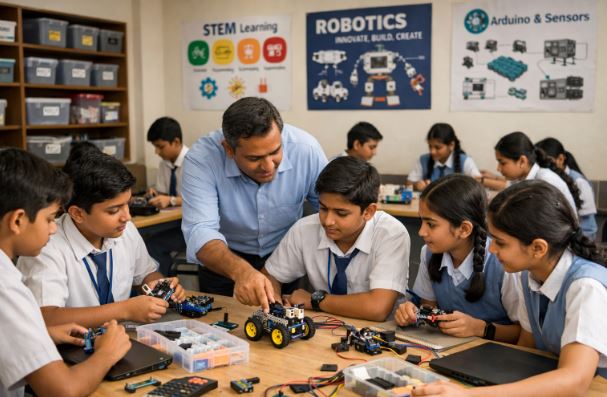
Technology is shaping the way students learn, think, and prepare for their future careers. Schools across India are now moving beyond traditional classroom teaching and adopting practical learning models that encourage creativity and innovation. One of the most impactful developments in this direction is the introduction of a robotics lab in school.
A robotics lab gives students hands-on exposure to coding, electronics, artificial intelligence, and automation. It transforms theoretical concepts into real-world applications.
As highlighted by leading STEM solution providers in India, robotics education supports experiential learning and aligns with the goals of NEP 2020. This blog explains how a robotics lab in school builds future ready skills and why it is becoming essential for modern education in 2026.
What Is A Robotics Lab In School?
A robotics lab in school is a dedicated learning space where students design, build, and program robots using structured STEM-based modules. It integrates science, technology, engineering, and mathematics into practical activities that enhance understanding and engagement.
Purpose of a School Robotics Lab
The primary goal of a robotics lab is to encourage experiential learning. Instead of only reading about circuits or programming concepts, students apply them in real time by assembling robotic models and writing code.
Students typically work with:
- Robotics kits designed for different grade levels
- Microcontrollers such as Arduino
- Sensors and actuators
- Coding platforms suitable for beginners and advanced learners
A robotics lab in school also promotes teamwork and collaboration. Students work in groups to solve challenges, test prototypes, and improve designs.
According to current education models adopted in Indian schools, robotics labs are structured to match age-appropriate learning outcomes, starting from basic mechanical models in primary classes to advanced AI applications in higher grades.
Why Is a Robotics Lab in School Important for STEM Education in India?
India is focusing strongly on STEM education and innovation-driven learning. NEP 2020 emphasises skill development, creativity, and critical thinking. A robotics lab in school supports these objectives by blending theory with practice.
Alignment with NEP 2020
Robotics labs encourage multidisciplinary learning. Students use mathematics for calculations, science for understanding sensors, and computer science for programming logic. This integration makes learning meaningful and practical.
Encouraging Innovation Culture
Many schools in India are inspired by models such as Atal Tinkering Labs. These initiatives aim to build problem solvers and innovators from an early age. A robotics lab in school creates a similar ecosystem where students explore ideas freely and experiment without fear of failure.
Key benefits include:
- Development of 21st-century skills
- Improved logical reasoning
- Exposure to automation and AI concepts
- Increased interest in engineering careers
By introducing robotics early, schools help students become confident learners who are ready for emerging technology-driven careers.
What Equipment and Infrastructure Are Required for a Robotics Lab in School?
Setting up a robotics lab in school requires proper planning and infrastructure. The lab does not need to be very large, but it must be organised and equipped with suitable tools.
Essential Equipment
A well-structured robotics lab generally includes:
- Robotics kits for various grade levels
- Arduino or similar microcontroller boards
- Raspberry Pi for advanced projects
- Sensors such as ultrasonic and infrared
- Motors and actuators
- Laptops or desktops for coding
- Internet connectivity for research and updates
Infrastructure Requirements
The lab should have proper electrical points, storage cabinets, and safe workstations. Adequate lighting and ventilation are important. Safety guidelines must be displayed clearly to ensure responsible use of equipment.
Below is a simple overview of the core components in a robotics lab in school:
| Component | Purpose in Learning | Suitable Grade Level |
| Basic Robotics Kit | Introduction to mechanics and simple coding | Primary |
| Arduino Board | Learning microcontroller programming | Middle |
| Raspberry Pi | Advanced computing and AI projects | Secondary |
| Sensors | Real world data collection | Middle and Secondary |
Modern labs in 2026 also integrate AI modules and IoT-based experiments to prepare students for advanced technologies.
How Does a Robotics Lab in School Improve Students’ Problem Solving and Critical Thinking Skills?
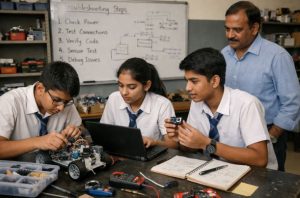
A robotics lab in school transforms passive learners into active problem solvers. When students build robots, they encounter challenges that require logical thinking and experimentation.
Building Computational Thinking
Students learn to break complex problems into smaller steps. Writing code helps them understand sequences, conditions, and loops. This strengthens their analytical skills.
Encouraging Creativity and Teamwork
Robotics projects often involve group tasks. Students collaborate, share ideas, and test multiple solutions. This improves communication and leadership skills.
Through project-based learning, students:
- Identify real-world problems
- Design solutions using robotics models
- Test and refine prototypes
- Present their findings confidently
Such hands-on learning improves retention and boosts confidence. It also prepares students for competitive exams, technical courses, and innovation challenges.
How to Setup Robotics Lab in School?
Setting up a robotics lab in school requires strategic planning. Schools should first define their objectives and target grade levels.
Step-by-Step Approach
First, assess available space and infrastructure. Next, choose suitable robotics kits based on curriculum requirements. Many Indian education providers offer structured programs aligned with CBSE and state boards.
Teacher training is equally important. Educators must be comfortable with coding platforms and hardware components. Training sessions ensure smooth implementation.
Budget and Planning
The robotics lab setup cost depends on the scale of implementation. Schools can begin with basic kits and gradually expand to advanced AI and IoT modules.
Important steps include:
- Defining curriculum structure
- Selecting reliable STEM partners
- Installing equipment
- Conducting teacher training
- Launching student orientation sessions
With proper planning, even mid-sized schools in India can successfully establish a robotics lab in school by 2026.
What Curriculum and Robotics Programs Are Suitable for Indian Schools?
A structured curriculum ensures that students progress systematically from basic to advanced concepts. Leading robotics education providers in India offer grade-wise modules.
Beginner Level
Students learn simple mechanical assembly, block-based coding, and basic sensor integration.
Intermediate Level
Students explore Arduino programming, automation concepts, and logic building exercises.
Advanced Level
Higher grade students work on AI-based projects, machine learning basics, and IoT applications.
Robotics programs should align with CBSE guidelines and national skill development goals. A well designed robotics lab in school includes lesson plans, activity books, and project assessments to measure learning outcomes effectively.
How Does a Robotics Lab in School Prepare Students for Future Careers in AI and Automation?
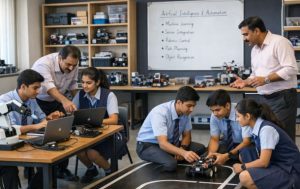
Automation, artificial intelligence, and robotics are shaping industries worldwide. Introducing these concepts in school builds early awareness and competence.
Career Readiness
Students exposed to robotics gain familiarity with programming languages, hardware integration, and system design. These skills are valuable for careers in robotics engineering, data science, and automation technology.
Competitive Edge
Participation in robotics competitions and innovation challenges enhances confidence and practical experience. Students learn to present ideas and work under deadlines.
A robotics lab in school bridges the gap between classroom education and industry requirements. It nurtures innovators who can contribute to India’s growing technology ecosystem.
Conclusion
A robotics lab in school is more than a modern facility. It is a transformative learning environment that encourages creativity, analytical thinking, and innovation. By integrating robotics, AI, and automation into everyday learning, schools in India are preparing students for the demands of 2026 and beyond.
With structured curriculum planning, proper infrastructure, and trained educators, a robotics lab can become a powerful platform for skill development. It supports STEM education, aligns with national policies, and builds future ready learners who are confident, capable, and technologically skilled.
FAQs
Can robotics education support overall academic performance?
Yes, robotics education improves logical reasoning and problem-solving abilities, which positively impact subjects such as mathematics and science.
Is coding mandatory for all robotics lab activities?
Coding is an important part of robotics, but beginner-level programs often use visual coding platforms that make learning simple and engaging.
How much time should schools allocate weekly for robotics sessions?
Most schools allocate one to two sessions per week to ensure consistent practice and project-based learning.
Are robotics labs suitable for rural schools in India?
Yes, scalable models and structured kits make it possible for rural schools to adopt robotics education with proper planning and support.
Do robotics labs help students participate in national innovation programs?
Robotics labs provide foundational skills that enable students to take part in innovation challenges, STEM competitions, and technology exhibitions.