
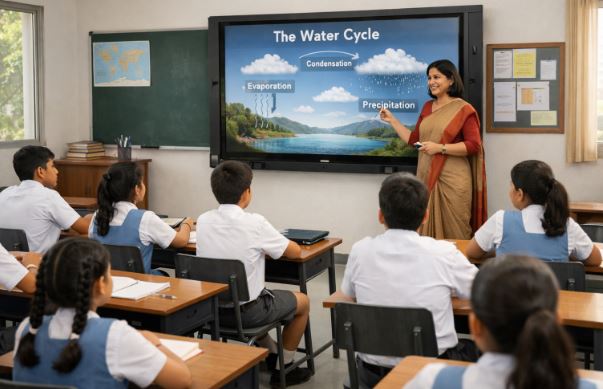
Education in India is rapidly evolving with the adoption of digital tools that make learning more engaging and effective. One such innovation that has transformed classroom teaching is the smart board.
As schools move away from chalk and duster methods, smart boards are becoming a central part of modern classrooms. They combine technology, visuals, and interaction to help teachers explain concepts clearly and help students understand lessons better.
With government initiatives supporting digital education and schools investing in smart classroom solutions, smart boards are shaping the future of school teaching in India.
This blog explains what a smart board is, how it works, and why it is considered an essential educational tool in today’s learning environment.
What is a Smart Board?

A smart board is an interactive digital display used in classrooms to enhance teaching and learning. It functions as an advanced version of a traditional whiteboard by allowing teachers and students to interact directly with the content displayed on the screen.
Unlike standard boards, smart boards connect to computers and educational software, enabling multimedia based teaching.
Smart boards are also known as interactive whiteboards and are widely used in schools across the world. Teachers can write, draw, open applications, play videos, and access online educational content in real time. Students can also interact with the board through touch based input, making learning more participative.
In Indian schools, smart boards are increasingly used to support visual learning and concept clarity. Subjects like mathematics, science, and geography benefit greatly from animated explanations and diagrams.
By integrating digital content with traditional teaching methods, smart boards create a balanced and effective learning environment that supports both teachers and students.
How Does a Smart Board Work in a Digital Classroom?
A smart board works by connecting a large interactive display to a computer system and educational software. The content displayed on the screen can be controlled using touch gestures, digital pens, or connected devices. This setup allows teachers to operate lessons directly from the board without switching between tools.
In a digital classroom, smart boards support various teaching activities such as presentations, live demonstrations, and interactive exercises. Teachers can save lessons, replay explanations, and share content with students for revision. Internet connectivity allows access to educational platforms, digital textbooks, and real time examples.
Important functions of smart boards include:
- Touch based navigation for easy interaction
- Multimedia support for videos and animations
- Annotation tools for highlighting key concepts
These features make classrooms more dynamic and interactive, encouraging students to participate actively rather than passively listening to lectures.
Why Are Smart Boards Important for Modern Teaching?
Smart boards play a significant role in modern teaching by improving how information is delivered and understood. Traditional teaching methods often rely heavily on verbal explanations, which may not suit all learning styles. Smart boards address this challenge by combining visual, audio, and interactive elements.
Modern students are more comfortable with technology, and smart boards align well with their learning habits. Teachers can explain complex topics using animations, diagrams, and simulations, making lessons more interesting and effective. This approach improves attention span and knowledge retention.
Smart boards also support inclusive education by catering to different learning speeds. Teachers can revisit topics, use recorded lessons, and provide additional visual support where needed. In Indian classrooms, where student strength is often high, smart boards help teachers manage lessons efficiently while maintaining quality education.
What Are the Key Features of a Smart Board for Schools?

Smart boards come with several features designed to enhance classroom teaching and learning experiences. These features support both teachers and students by making lessons interactive and organised.
Key features include:
- Interactive touch screen for writing and navigation
- Support for educational software and digital content
- Screen recording for lesson revision
Smart boards also allow content sharing across devices, enabling collaborative learning. Teachers can integrate quizzes, diagrams, and videos into a single lesson. The ability to save and reuse content saves time and ensures consistency in teaching.
For schools, these features improve classroom management and teaching efficiency. Smart boards also reduce dependency on physical teaching materials, supporting environmentally friendly education practices.
How Does a Smart Board Improve Student Learning Outcomes?
Smart boards significantly improve student learning outcomes by promoting active participation and better understanding. Visual representation of concepts helps students grasp difficult topics more easily compared to text based explanations.
Interactive activities such as quizzes and problem solving exercises encourage students to engage directly with the lesson. This active involvement boosts confidence and improves critical thinking skills. Students also benefit from collaborative learning, where they can work together on tasks displayed on the board.
Smart boards support different learning styles including visual, auditory, and kinaesthetic learners. By offering a flexible learning environment, smart boards help students retain information longer and perform better academically. In Indian schools, this approach is especially beneficial in improving overall classroom engagement and performance.
What Are the Advantages of Using Smart Boards in Indian Classrooms?
The adoption of smart boards in Indian classrooms offers several advantages aligned with the country’s digital education goals. They help bridge the gap between traditional education and modern technology based learning.
Advantages include:
- Enhanced student engagement and interest
- Better explanation of complex topics
- Support for digital learning initiatives
Smart boards also help teachers deliver standardised lessons across multiple classrooms. Rural and urban schools alike benefit from access to quality digital content. With multilingual support and visual aids, smart boards help overcome language and comprehension barriers, making education more inclusive and effective.
Is a Smart Board the Future of School Teaching in India?

Smart boards are widely considered the future of school teaching in India due to their adaptability and effectiveness. As education systems focus on skill based learning and digital literacy, smart boards support these goals by integrating technology into daily teaching.
They prepare students for a technology driven world by familiarising them with digital tools from an early age. Teachers also benefit from continuous updates in educational software and content. With increasing investment in smart classroom infrastructure, smart boards are expected to become a standard feature in Indian schools.
By combining innovation with education, smart boards are transforming classrooms into interactive learning spaces that encourage curiosity, creativity, and understanding.
Conclusion
Smart boards have emerged as a powerful educational tool that enhances the quality of teaching and learning in schools. By integrating interactive technology with traditional teaching methods, they make classrooms more engaging, inclusive, and effective.
In India, where education is rapidly embracing digital transformation, smart boards play a crucial role in shaping the future of school teaching.
Their ability to improve student engagement, support teachers, and align with modern learning needs makes them an essential part of today’s education system.
FAQs
How is a smart board different from a traditional whiteboard?
A smart board allows digital interaction, multimedia display, and content saving, while a traditional whiteboard is limited to manual writing.
Can smart boards be used for online and hybrid learning?
Yes, smart boards support digital platforms and content sharing, making them suitable for online and hybrid teaching models.
Are smart boards suitable for primary school students?
Smart boards are suitable for all age groups as they support visual learning and interactive activities that engage young learners.
Do smart boards help teachers save time?
Smart boards help teachers save time by allowing lesson reuse, quick access to content, and efficient classroom management.
Is training required to use a smart board effectively?
Basic training is recommended, but smart boards are designed to be user-friendly and easy for teachers to adopt.