
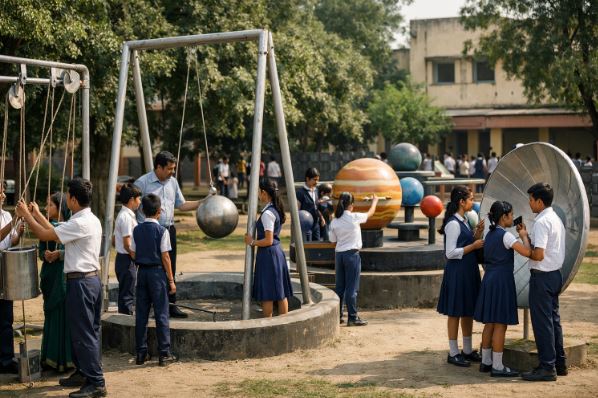
Science becomes truly meaningful when students can see, touch, and experience it in real life. Many schools focus heavily on textbook learning, but practical exposure often remains limited to indoor laboratories.
This is where VAPS Science Park transforms the way science is taught and understood. Designed as an interactive open air learning environment, VAPS Science Park allows students to explore scientific principles through engaging models installed within the school campus.
By bringing theory into practice, VAPS Science Park helps students understand mechanics, optics, physics, mathematics, and chemistry in a simple and enjoyable manner.
Instead of restricting science inside four walls, it creates a space where children discover concepts informally through interaction. The following sections explain what activities VAPS Science Park offers for schools and how it supports experiential education in India.
What Activities Does VAPS Science Park Offer for Schools?
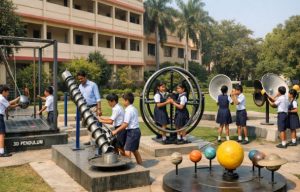
VAPS Science Park offers a cluster of interactive outdoor display models that demonstrate important scientific principles. These models are carefully designed to convert theoretical classroom lessons into practical experiences.
Students are encouraged to operate the equipment themselves, observe outcomes, and relate them to what they have studied.
Interactive Open Air Learning
The park functions as an open air science lab where students can freely explore during leisure time. Instead of memorising formulas, they witness real time demonstrations of motion, force, light, sound, and energy.
Informal Discovery of Science
Children interact with gadgets and discover concepts naturally. This informal approach builds curiosity and confidence. It promotes scientific literacy not only among students but also among the general public who visit the campus.
The activities include experiments related to motion, pendulums, optics, waves, solar movements, and mechanical systems. Each installation is built to ensure safety, durability, and long term usage for schools.
How Do Interactive Science Park Models Enhance Practical Learning in Schools?
Interactive science park models encourage hands on learning. When students rotate a gyroscope, pull a pulley system, or observe light through a prism, they gain conceptual clarity that textbooks alone cannot provide.
Bridging Theory and Application
Science park models support topics from school curriculum in physics, mathematics, and chemistry. For example, Newton’s third law becomes easier to understand when students observe action and reaction using a working model.
Some of the practical learning benefits include:
- Clear understanding of force, motion, and momentum
- Real time demonstration of optical illusions and light spectrum
- Observation of sound waves through echo tubes and musical pipes
- Visualisation of planetary movements using a scale model of the solar system
By engaging multiple senses, students retain information better and develop analytical thinking skills. This experiential learning approach supports STEM education in Indian schools.
Which Interactive Models Are Available in the VAPS Science Park for Students?
VAPS Science Park offers a wide range of models across different scientific domains. These models are designed to suit different age groups and curriculum requirements.
Physics and Mechanics Models
Students can explore concepts using models such as 3D Pendulum, Angular Momentum, Archimedes Screw, Centrifugal Force, Inclined Plane, Loop the Loop, Principle of Lever, Weight and Pulley, Wheel and Axel, and Newton’s Cradle.
Optics and Light-Based Installations
Optical learning becomes exciting with models like Prism, Newton’s Colour Disc, Cube Optical Illusion, Mirrors, Concave and Convex, Spectrum from Crystal Glass Prism, Sun Filters, and Optical Illusion panels.
Sound and Wave Experiments
Models such as the Echo Tube, Musical Pipes, Noise Resonator, Transverse Waves, Wave Pendulum, and Sympathetic Swing demonstrate wave motion and sound principles.
Astronomy and Time Measurement
The park also includes Vertical Sundial, Equatorial Sundial, Solar System model with Sun diameter of 1.5 meters, Samrat Yanthra, Naadivalaya, and Dakshinottara Bhitti.
These models are customisable to fit school requirements and available space.
What Are the Silver, Gold, and Platinum Packages Offered by VAPS Science Park?
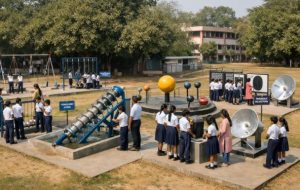
VAPS Science Park provides structured packages to help schools choose models according to their budget and infrastructure.
Silver Package
The Silver Package includes 20 models such as Angular Momentum, Camera, Colour Contrast, Cube Optical Illusion, Musical Pipes, Parabolic Dishes, Uphill Cone, Vertical Sundial, and Solar spectrum experiments. It is ideal for schools starting with a compact science park.
Gold Package
The Gold Package offers 30 models including 3D Pendulum, Archimedes Screw, Echo Tube, Loop the Loop, Newton’s third law, Principle of Lever, Solar System model, and Types of Power Transmission. It provides broader curriculum coverage.
Platinum Package
The Platinum Package includes 50 advanced models such as Newton’s Cradle, Roberval Balance, Stroboscope, Persistence of Vision, Penrose Triangle, Balancing the Pipe, and Race of Rolling Disc. It is suitable for schools seeking a comprehensive science infrastructure.
Schools can customise these packages based on available space and educational goals.
How Does an Outdoor Science Park Promote STEM Learning and Scientific Literacy?
An outdoor science park encourages curiosity driven learning. When students engage with scientific equipment in a relaxed environment, they feel motivated to explore deeper.
Encouraging Curiosity
Open-access installations attract students during free periods. They voluntarily experiment and discuss observations with peers.
Building Scientific Temper
By interacting with models, students develop questioning skills. They understand cause and effect relationships and learn to interpret results logically.
STEM learning improves because concepts are demonstrated visually and physically. This approach strengthens problem-solving abilities and enhances overall academic performance.
Why Should Schools Choose the VAPS Science Park Solution for Experiential Education?
VAPS Science Park stands out because of its structured implementation and long-term support.
Key Features
- More than 30 interactive models for flexible setup
- Durable equipment ensuring minimal maintenance
- Complete faculty training for effective usage
- Dedicated support for repairs and maintenance
- Study materials that connect practical experience with theory
- Flexible cost options to suit different budgets
VAPS ensures that teachers receive knowledge transfer sessions so they can guide students effectively. The models are built with quality materials to withstand outdoor conditions for years.
How Can Schools Implement a Customised VAPS Science Park Setup?
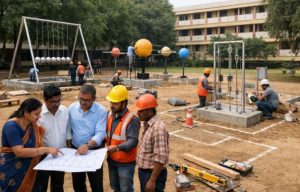
Implementing a science park begins with planning the available open space within the campus. VAPS assists schools in selecting suitable models according to curriculum alignment and student strengths.
Planning and Installation
The team analyses the area, recommends appropriate equipment, and ensures safe installation. Schools can choose between Silver, Gold, or Platinum packages or request a customised combination.
Long-Term Educational Value
Once installed, the science park becomes a permanent experiential learning zone. It supports regular classroom teaching and enhances institutional reputation by showcasing innovative infrastructure.
With proper maintenance and faculty involvement, the science park continues to deliver value for many academic years.
Conclusion
VAPS Science Park offers a practical, engaging, and innovative solution for schools that want to move beyond traditional teaching methods. By providing interactive models across physics, optics, mechanics, sound, and astronomy, it transforms school campuses into vibrant learning spaces.
The structured packages, durable equipment, faculty training, and dedicated support make implementation smooth and sustainable. Most importantly, students gain confidence, curiosity, and conceptual clarity through real experiences.
For schools aiming to strengthen STEM education and promote scientific literacy, VAPS Science Park presents a comprehensive and future-ready solution in 2026 and beyond.
Frequently Asked Questions
How much space is required to install a science park in a school campus?
The required space depends on the chosen package and number of models. Schools with moderate open areas can begin with compact setups like the Silver Package and expand gradually.
Are VAPS Science Park models aligned with CBSE, ICSE, and State Board curriculum?
Yes, the models are designed to demonstrate core scientific principles that are part of standard school curricula across major Indian education boards.
What maintenance support is provided after installation?
VAPS provides dedicated support for maintenance and repairs. The equipment is built for durability, ensuring minimal upkeep for schools.
Can rural or budget schools opt for smaller science park setups?
Yes, flexible cost options and customised model combinations allow schools with limited budgets to implement a suitable science park.
How does outdoor learning improve student engagement compared to classroom learning?
Outdoor learning allows students to interact physically with concepts, making lessons more memorable and engaging than purely theoretical classroom sessions.